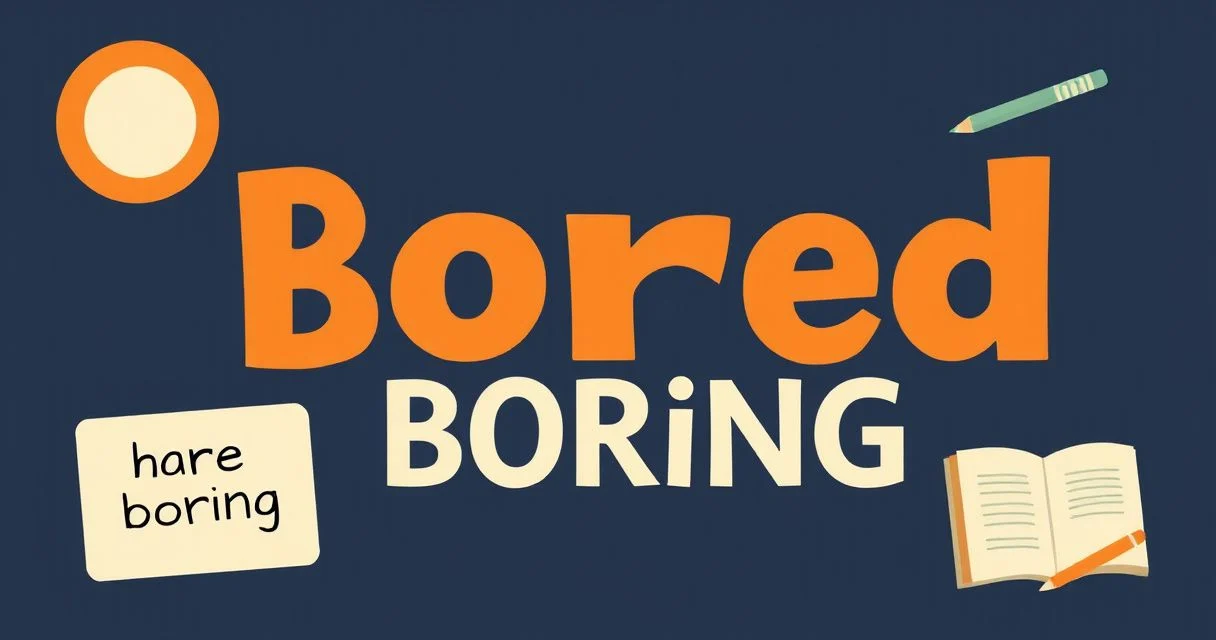
Bored or Boring: The Two Endings That Change Who You Are Talking About
I am boring.
Every English teacher has heard a student say this while meaning the opposite, and every one of them has had to explain that the sentence is grammatically perfect and says something quite different from what was intended.
The distinction
Many English adjectives come in pairs built from the same verb — one ending in -ed, one in -ing. They are not interchangeable, and the difference is consistent:
- -ed describes the person who experiences the feeling. I am bored.
- -ing describes the thing that causes it. The lecture is boring.
So I am boring is a confession, not a complaint.
The pairs you will meet most
- interested / interesting
- excited / exciting
- confused / confusing
- tired / tiring
- surprised / surprising
- frustrated / frustrating
- embarrassed / embarrassing
- frightened / frightening
- satisfied / satisfying
- disappointed / disappointing
Nearly all of them come from verbs about affecting someone’s state of mind, which is why the pattern holds so reliably across the set.
Why the rule works
These are participles doing adjective duty, and they keep the roles they had as verbs.
Take the verb to bore. Something bores somebody. The thing doing the boring is the active participant — boring, the present participle. The person it happens to is the passive one — bored, the past participle.
The lecture bored me becomes the lecture was boring and I was bored. Both adjectives come from the same sentence; they just describe opposite ends of it.
Once you see that, you never need the list. Ask which side of the verb the thing is on.
Where it is not a mistake
People can legitimately take either ending, which is where confidence in the rule starts to matter.
- She was bored — she felt boredom.
- She was boring — she caused it in others.
- He is frightened — he feels fear.
- He is frightening — he causes it.
Both sentences in each pair are correct English. Only the context tells you which is intended, which is precisely why the error is so easy to miss when proofreading your own writing — nothing looks broken.
Two genuine traps
Things can be described with -ed if something acted on them. A tired horse, a broken window, a finished report. The -ed form is not restricted to people; it is restricted to whatever received the action.
Some -ing adjectives are not from this family at all. A running tap, a sleeping child, a rising tide simply describe something in the act of doing. There is no paired -ed adjective and no cause-and-effect relationship. If the verb is not about affecting someone’s feelings, the rule does not apply.
The test
Turn the sentence back into the verb it came from, and see which side your subject lands on.
The film was ___. Did the film do the interesting, or did it receive it? It did the interesting: interesting.
I was ___ by the film. The film acted on you: interested.
Two seconds of thought, and you never accidentally tell a room full of people that you are boring.
Checked against Merriam-Webster, the Chicago Manual of Style and the AP Stylebook. Spotted an error? Tell us — see our editorial policy.