
Adjectives for Imagery: Words to Describe and Create Imagery
The adjectives most often used to describe imagery are vivid, evocative, striking, stark, lush, haunting, visceral and precise, and imagery is also named by the sense it appeals to: visual (sight), auditory (sound), tactile (touch), olfactory (smell) and gustatory (taste). In an essay, pair one of these words with the effect the image has: “Owen’s visceral imagery forces the reader to share the soldiers’ exhaustion.”
This page has two halves. The first is for literary analysis: words that describe imagery, the sense types, weak and strong analysis words, and model essay sentences. The second is for your own writing: sensory adjectives that create imagery, with examples. For words about poems as a whole, see adjectives for poems; for literature more broadly, adjectives for literature.
Quick picker
| The imagery is… | Adjective |
|---|---|
| so clear you can picture it at once | vivid, sharp, precise, concrete |
| calling up feelings or memories | evocative, suggestive, resonant |
| bare, harsh, with no softening | stark, austere, bleak, unflinching |
| rich and full of growth or colour | lush, rich, sumptuous, opulent |
| physical, felt in the body | visceral, sensuous, tactile |
| disturbing and hard to forget | haunting, unsettling, grotesque, nightmarish |
| gentle and calm | tranquil, pastoral, delicate, muted |
| surprising or unusual | striking, startling, original, arresting |
| repeated across a text | recurring, recurrent, sustained, extended |
Recommended resources for this topic
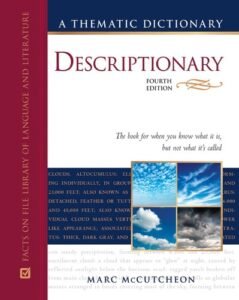
The Descriptionary
by Marc McCutcheon
A thematic dictionary that gives the exact word for things you can only describe.
Roget's Thesaurus of English Words and Phrases
by Peter Mark Roget
The classic thesaurus, arranged by idea, for finding a better word.
Merriam-Webster's Vocabulary Builder
by Mary Wood Cornog
Builds vocabulary through word roots, with quizzes along the way.
As an Amazon Associate we earn from qualifying purchases. Disclosure
Adjectives that describe imagery in analysis
Each of these makes a different claim about an image, so choose the one you can support with the text.
| Adjective | What you are claiming | Model sentence |
|---|---|---|
| vivid | the image is clear and lifelike | In William Carlos Williams’s poem, the vivid image of the “red wheel barrow” makes an ordinary object feel important. |
| evocative | it calls up a mood, memory or feeling | Keats’s evocative opening, “Season of mists and mellow fruitfulness”, creates autumn as a feeling as much as a season. |
| striking / arresting | it catches attention because it is unexpected | Pound’s striking comparison of faces in a crowd to “Petals on a wet, black bough” turns a busy station into a still picture. |
| stark | bare and harsh, without decoration | The stark imagery of empty fields mirrors the speaker’s loneliness. |
| lush | rich, abundant, often of plants or colour | Lush imagery of fruit and flowers fills the garden scenes with abundance. |
| haunting | it stays with the reader, often sadly | The haunting image of the drowned bell recurs in the final stanza. |
| visceral | it is felt physically, in the gut | Owen’s visceral imagery of men “Bent double, like old beggars under sacks” makes exhaustion physical. |
| sensuous | it appeals richly to the senses (not the same as sensual) | The poem’s sensuous imagery of warmth and taste slows the reader down. |
| concrete | it uses specific, physical things rather than abstractions | Concrete images, a cracked cup and a cold stove, show poverty without naming it. |
| grotesque | distorted, ugly or unnatural, often deliberately | The grotesque imagery of the feast turns celebration into horror. |
| pastoral | of idealised country life | The pastoral imagery of the first act sets up the city as a place of corruption. |
| recurring / extended | it returns or is developed over many lines | The recurring imagery of light and darkness tracks the character’s moral choices. |
Sensuous and sensual are often confused. Sensuous means appealing to the senses in general; sensual usually suggests physical, often sexual, pleasure. In analysis, sensuous imagery is almost always the word you want.
Types of imagery by sense
These are the standard labels used in literature classes. Some textbooks add two more: kinesthetic imagery (movement and the body’s effort) and organic imagery (inner sensations such as hunger, fatigue or fear).
| Type | Sense | Example of the kind of detail |
|---|---|---|
| visual | sight | colour, light, shape: “the bruised purple sky” |
| auditory | hearing | sound and silence: “the hiss of rain on hot pavement” |
| tactile | touch | texture, temperature, pressure: “the cold, slick rail” |
| olfactory | smell | “the sour smell of the bins in August” |
| gustatory | taste | “the bitter, metallic taste of fear” |
| kinesthetic | movement | “the jolt of the train as it lurched forward” |
| organic | internal feeling | “the hollow ache of hunger” |
Owen’s “Dulce et Decorum Est” is a useful text for practising these labels: in the gas attack the reader hears “guttering, choking, drowning” (auditory), sees a dying man through “thick green light” (visual) and feels the men’s stumbling exhaustion (kinesthetic and organic).
Weak and strong analysis words
Examiners and teachers often comment on vague analysis. The fix is usually a more exact adjective plus an effect.
| Weak | Stronger | Why it is better |
|---|---|---|
| good imagery | precise, vivid, controlled imagery | Good judges without saying what the imagery does. |
| descriptive imagery | sensory, concrete, detailed imagery | All imagery is descriptive; say what kind. |
| nice imagery | gentle, tranquil, lush imagery | Nice has no content. |
| dark imagery | bleak, menacing, funereal imagery | Dark is fine but very common; be specific about the mood. |
| powerful imagery | visceral, haunting, unflinching imagery | Powerful is a cliché in essays; name the kind of power. |
| the imagery is interesting | the imagery is startling / unusual / paradoxical | Say why it holds attention. |
How to write about imagery in an essay
A reliable pattern is: name the image, describe it with one exact adjective, then state the effect.
- “The stark image of the bare tree suggests that the speaker’s hope has died with the summer.”
- “Through recurring auditory imagery, especially the ticking clock, the writer builds a sense of time running out.”
- “The evocative olfactory detail of ‘bread still warm from the oven’ links home with comfort, which makes its loss more painful.”
- “By contrasting lush imagery in the garden with stark imagery in the town, the author divides the novel into two moral worlds.”
Model analysis paragraph: In the opening stanza of “Dulce et Decorum Est”, Owen replaces the heroic picture of soldiers with visceral, unflinching imagery. The men are “Bent double, like old beggars under sacks”, a simile that makes young soldiers look aged and broken. The imagery is mostly kinesthetic: the soldiers trudge and limp, and the reader feels their weight. By making exhaustion physical rather than describing it in abstract words, Owen prepares the reader to reject the “old Lie” of the poem’s final lines.
Adjectives that create imagery in your own writing
When you are the writer, imagery comes from concrete, sensory adjectives: words a reader can see, hear, feel, smell or taste. Abstract adjectives such as beautiful, amazing or scary tell the reader what to feel; sensory ones let them feel it.
- Sight: glinting, hazy, mottled, bruised, sun-bleached, flickering. “The sun-bleached sign still promised COLD DRINKS.”
- Sound: muffled, shrill, rasping, crackling, hushed. “A muffled thud came from the room upstairs.” More in adjectives for sounds.
- Touch: clammy, gritty, velvety, brittle, sticky. “Her hands were clammy on the steering wheel.” More in adjectives for touch.
- Smell: musty, acrid, briny, smoky, yeasty. “The acrid smell of burnt toast reached the stairs before he did.”
- Taste: tart, bitter, salty, smoky, sharp. “The tea was stewed and bitter, the way her grandfather liked it.” More in adjectives for taste.
Before: The kitchen was nice and smelled good. After: The kitchen was warm and steamy, and it smelled of onions frying in butter. The second version uses only three adjectives, but each one is something a reader can sense.
In exam writing (for example B2 or C1 essays and stories), one precise sensory adjective per sentence is usually enough. Vary the senses rather than stacking three sight words, and check that every adjective tells the reader something they could not guess.
Common mistakes
| Mistake | Correct | Why |
|---|---|---|
| a beautiful, red dress | a beautiful red dress | The adjectives are cumulative (you could not say “red and beautiful dress” naturally), so no comma. |
| The cat was soft, fluffy. | The cat was soft and fluffy. | After a verb, two adjectives need and, not just a comma. |
| The poem has many imageries. | The poem has a lot of imagery. / The poem has many images. | Imagery is uncountable; image is the countable word. |
| imagry | imagery | Spelling: image + ry. |
| sensual imagery of autumn fruit | sensuous imagery of autumn fruit | Sensuous is the general sensory word. |
| vivid, vivid, vivid | vivid, then precise, sharp, concrete | Repeating one adjective through an essay makes the analysis sound thin. |
Practice
- “The hiss of the kettle and the clatter of plates” is ______ imagery. (visual / auditory / gustatory)
- Bare, harsh imagery with no softening is ______. (lush / stark / pastoral)
- Imagery that appeals richly to the senses is ______. (sensuous / sensual / sensitive)
- “The smell of wet dog filled the car” uses ______ imagery. (tactile / olfactory / kinesthetic)
- Improve the analysis: “The writer uses good imagery.”
- Correct: “The story contains many imageries of the sea.”
- Which adjective suggests an image stays with the reader long after: haunting, concrete or recurring?
Answers: 1. auditory. 2. stark. 3. sensuous. 4. olfactory. 5. For example: “The writer uses precise visual imagery of the empty street to suggest isolation.” 6. “The story contains a lot of imagery of the sea” or “many images of the sea”. 7. haunting.
Quick answers
What is a good adjective to describe imagery?
Vivid is the most common; evocative, striking, stark, visceral and haunting make more specific claims. Choose the one you can prove with a quotation.
What are the five types of imagery?
Visual (sight), auditory (sound), tactile (touch), olfactory (smell) and gustatory (taste). Many courses add kinesthetic (movement) and organic (inner feeling).
What is the difference between imagery and description?
Description is any account of what something is like. Imagery is language that makes the reader experience it through the senses. “The room was untidy” is description; “socks on the lampshade and a sticky plate under the bed” is imagery.
Is “vivid imagery” a cliché?
It is very common in essays, so it can sound automatic. It is fine once; after that, use a more exact word and explain the effect.
For a wider bank of descriptive vocabulary, see describing words.
Checked against Merriam-Webster, the Chicago Manual of Style and the AP Stylebook. Spotted an error? Tell us — see our editorial policy.