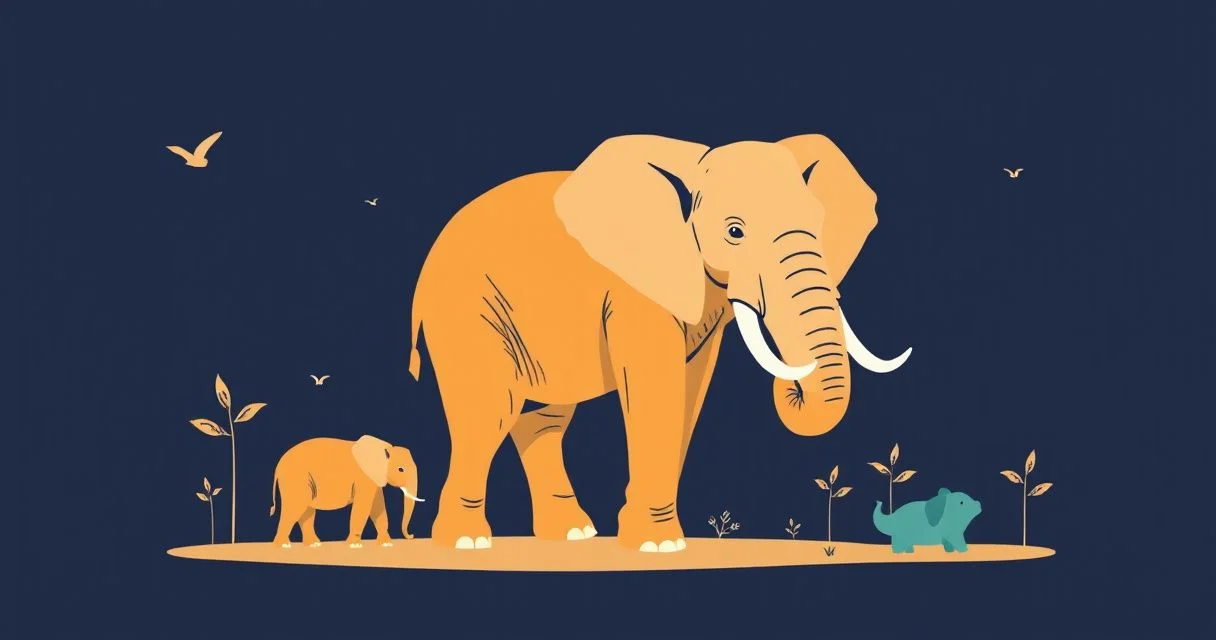
Describing Elephants: A Guide to Adjectives
Elephants, the gentle giants of our world, captivate us with their intelligence, size, and complex social structures. Describing these magnificent creatures effectively requires a rich vocabulary of adjectives. Understanding the nuances of adjectives allows us to paint vivid pictures of elephants, capturing their physical attributes, behaviors, and the emotions they evoke. This comprehensive guide explores a wide range of adjectives for describing elephants, providing examples, usage rules, and practice exercises. Whether you’re a student, writer, or simply an elephant enthusiast, this article will enhance your ability to articulate the wonder of these incredible animals.
This article is designed for learners of all levels, from beginners to advanced English speakers. By the end of this guide, you will have a solid understanding of how to use adjectives effectively to describe elephants in various contexts. This knowledge will improve your writing and speaking skills, allowing you to express yourself with greater precision and creativity.
Table of Contents
- Definition of Adjectives
- Structural Breakdown of Adjective Use
- Types and Categories of Adjectives
- Examples of Adjectives for Elephants
- Usage Rules for Adjectives
- Common Mistakes with Adjectives
- Practice Exercises
- Advanced Topics in Adjective Usage
- Frequently Asked Questions
- Conclusion
Definition of Adjectives
An adjective is a word that modifies a noun or pronoun, providing more information about it. Adjectives describe the qualities, characteristics, or properties of the noun they modify. They answer questions like “What kind?”, “Which one?”, “How many?”, or “How much?”. Adjectives are essential for creating detailed and descriptive language, allowing us to paint a more vivid picture in the reader’s mind. For example, instead of simply saying “elephant,” we can say “massive elephant” or “gentle elephant,” adding depth and clarity to our description.
Adjectives can be classified based on their function and the type of information they convey. Some adjectives describe physical attributes, while others describe emotional states or behavioral traits. Understanding these classifications helps us choose the most appropriate adjectives to effectively describe a noun. In the context of describing elephants, we might use adjectives like “gray,” “wrinkled,” or “enormous” to describe their physical appearance, or “intelligent,” “social,” or “protective” to describe their behavior.
Structural Breakdown of Adjective Use
Adjectives typically appear before the noun they modify, but they can also follow a linking verb (such as is, are, was, were, seems, becomes). When an adjective precedes a noun, it is called an attributive adjective. When it follows a linking verb, it is called a predicative adjective. The placement of the adjective can subtly change the emphasis of the sentence.
For example, in the sentence “The large elephant drank water,” the adjective “large” is an attributive adjective because it comes before the noun “elephant.” In the sentence “The elephant is large,” the adjective “large” is a predicative adjective because it follows the linking verb “is.” Both sentences convey similar information, but the first emphasizes the size of the elephant, while the second simply states its size as a characteristic.
Types and Categories of Adjectives
Adjectives can be categorized into several types based on their function and meaning. Understanding these categories can help you choose the most appropriate adjective for a given context.
Descriptive Adjectives
Descriptive adjectives, also known as qualitative adjectives, describe the qualities or characteristics of a noun. They answer the question “What kind?” Examples include: gray, large, wrinkled, strong, gentle.
Quantitative Adjectives
Quantitative adjectives indicate the quantity or amount of a noun. They answer the question “How many?” or “How much?” Examples include: many, few, several, some, all. While it’s less common to use them directly with individual elephants, you might use them when discussing populations: “Many elephants live in Africa.”
Demonstrative Adjectives
Demonstrative adjectives specify which noun is being referred to. The demonstrative adjectives are this, that, these, and those. Examples include: “This elephant is very old,” or “Those elephants are part of a herd.”
Possessive Adjectives
Possessive adjectives indicate ownership or possession. The possessive adjectives are my, your, his, her, its, our, and their. Examples include: “Its trunk is very long” (referring to an elephant’s trunk) or “The zoo keepers take great pride in their elephants.”
Interrogative Adjectives
Interrogative adjectives are used to ask questions about a noun. The interrogative adjectives are which and whose. Examples include: “Which elephant is the oldest?” or “Whose elephant is that?”
Proper Adjectives
Proper adjectives are formed from proper nouns and modify other nouns. Examples include: “African elephant” or “Indian elephant.”
Compound Adjectives
Compound adjectives are formed by combining two or more words, often with a hyphen. Examples include: “Long-lived elephants,” “well-trained elephants,” or “thick-skinned elephant.”
Examples of Adjectives for Elephants
Here are some examples of adjectives used to describe elephants, categorized by different aspects of the elephant.
Physical Attributes
This table provides examples of adjectives that describe the physical attributes of elephants. These adjectives help to create a clear picture of the elephant’s appearance.
| Adjective | Example Sentence |
|---|---|
| Enormous | The enormous elephant lumbered across the savanna. |
| Massive | A massive elephant blocked our path. |
| Large | The large elephant flapped its ears. |
| Gigantic | A gigantic elephant emerged from the trees. |
| Huge | The huge elephant sprayed water on itself. |
| Gray | The gray elephant blended into the dusty landscape. |
| Wrinkled | The wrinkled elephant’s skin showed its age. |
| Thick-skinned | The thick-skinned elephant was protected from the sun. |
| Tuseless | The tuseless elephant was still a majestic creature. |
| Long-trunked | The long-trunked elephant reached for a branch. |
| Powerful | The powerful elephant could uproot small trees. |
| Heavy | The heavy elephant left deep footprints in the mud. |
| Tall | The tall elephant towered over the other animals. |
| Big-eared | The big-eared elephant used its ears to cool down. |
| Stocky | The stocky elephant moved with surprising agility. |
| Ivory-tusked | The ivory-tusked elephant was a sight to behold. |
| Old | The old elephant was the matriarch of the herd. |
| Young | The young elephant stayed close to its mother. |
| Healthy | The healthy elephant thrived in the wild. |
| Strong | The strong elephant could carry heavy loads. |
| Lean | The lean elephant was searching for food. |
| Well-fed | The well-fed elephant looked content. |
| Healthy | The healthy elephant thrived in its habitat. |
Behavioral Traits
This table shows adjectives that describe the behavioral traits of elephants. These adjectives provide insight into their character and actions.
| Adjective | Example Sentence |
|---|---|
| Intelligent | The intelligent elephant solved the puzzle quickly. |
| Social | Elephants are social animals that live in herds. |
| Gentle | The gentle elephant carefully approached the baby. |
| Protective | The protective elephant defended its young. |
| Curious | The curious elephant investigated the strange object. |
| Playful | The playful elephant splashed in the water. |
| Aggressive | The aggressive elephant charged at the intruder. |
| Calm | The calm elephant remained unfazed by the noise. |
| Wise | The wise elephant led the herd to water. |
| Noisy | The noisy elephants trumpeted loudly. |
| Quiet | The quiet elephant moved stealthily through the forest. |
| Alert | The alert elephant sensed danger. |
| Docile | The docile elephant obeyed the trainer’s commands. |
| Mischievous | The mischievous elephant tugged at the tourist’s hat. |
| Stubborn | The stubborn elephant refused to move. |
| Trained | The trained elephant performed tricks for the audience. |
| Wild | The wild elephant roamed freely across the plains. |
| Domesticated | The domesticated elephant worked in the logging industry. |
| Cooperative | The cooperative elephants worked together to lift the log. |
| Loyal | The loyal elephant stayed by its companion’s side. |
| Observant | The observant elephant noticed the subtle changes in the environment. |
| Resourceful | The resourceful elephant used its trunk to reach high branches. |
| Attentive | The attentive elephant listened carefully to the sounds of the forest. |
Emotional States
This table provides adjectives that describe the emotional states of elephants. These adjectives help convey the elephant’s feelings and inner experiences.
| Adjective | Example Sentence |
|---|---|
| Happy | The happy elephant trumpeted with joy. |
| Sad | The sad elephant mourned the loss of its friend. |
| Angry | The angry elephant charged at the poachers. |
| Content | The content elephant grazed peacefully in the field. |
| Fearful | The fearful elephant ran from the fire. |
| Lonely | The lonely elephant wandered away from the herd. |
| Joyful | The joyful elephant celebrated the birth of a calf. |
| Distressed | The distressed elephant cried out for help. |
| Anxious | The anxious elephant paced back and forth. |
| Calm | The calm elephant enjoyed the shade of the tree. |
| Excited | The excited elephant anticipated the arrival of the rain. |
| Peaceful | The peaceful elephant rested in the sun. |
| Relaxed | The relaxed elephant lay down in the mud. |
| Tired | The tired elephant slept soundly. |
| Restless | The restless elephant couldn’t stay still. |
| Playful | The playful elephant chased butterflies in the meadow. |
| Curious | The curious elephant investigated the new scent. |
| Hopeful | The hopeful elephant searched for water during the drought. |
| Vulnerable | The vulnerable elephant calf needed protection. |
| Determined | The determined elephant worked hard to overcome the obstacle. |
| Affectionate | The affectionate elephant nuzzled its calf. |
| Sympathetic | The sympathetic elephant seemed to understand the other animal’s pain. |
Environmental Context
This table includes adjectives that describe the elephant in relation to its environment. These adjectives provide context and help to understand the elephant’s role in its ecosystem.
| Adjective | Example Sentence |
|---|---|
| Wild | The wild elephant roamed freely across the savanna. |
| Endangered | The endangered elephant needs our protection. |
| African | The African elephant has larger ears than its Asian counterpart. |
| Asian | The Asian elephant is often used in logging. |
| Savanna | The savanna elephant thrived in the open grasslands. |
| Forest | The forest elephant preferred the dense jungle. |
| Migratory | The migratory elephants followed the seasonal rains. |
| Solitary | The solitary elephant lived apart from the herd. |
| Captive | The captive elephant lived in a zoo. |
| Free-ranging | The free-ranging elephants had plenty of space to roam. |
| Protected | The protected elephant lived in a sanctuary. |
| Vulnerable | The vulnerable elephant was at risk from poachers. |
| Native | The native elephants were part of the local ecosystem. |
| Roaming | The roaming elephant traveled long distances. |
| Local | The local elephants were well-adapted to the area. |
| Rural | The rural elephants often came into contact with farmers. |
| Natural | The natural elephant habitat was under threat. |
| Remote | The remote elephant population was difficult to study. |
| Isolated | The isolated elephant group had unique characteristics. |
| Wilderness | The wilderness elephant thrived in the untouched landscape. |
| Thriving | The thriving elephant population was a sign of conservation success. |
| Declining | The declining elephant numbers were a cause for concern. |
Usage Rules for Adjectives
Using adjectives correctly involves understanding their placement in sentences, their order when multiple adjectives are used, and how to form comparative and superlative degrees.
Adjective Order
When using multiple adjectives before a noun, there is a general order to follow, although it’s not a rigid rule. The typical order is: opinion, size, age, shape, color, origin, material, and purpose. This order ensures clarity and natural-sounding sentences. For instance, “a beautiful large old gray elephant” sounds more natural than “a gray old large beautiful elephant.” However, it’s important to note that using more than three adjectives before a noun can sound awkward, and it’s often better to rephrase the sentence.
Here’s an example applying it to elephants: “The magnificent huge African elephant crossed the river.” In this sentence, “magnificent” is an opinion, “huge” is a size, and “African” is an origin.
Comparative and Superlative Forms
Adjectives can be used to compare two or more nouns. The comparative form is used to compare two things, while the superlative form is used to compare three or more things. For most short adjectives (one or two syllables), the comparative is formed by adding “-er” and the superlative by adding “-est.” For longer adjectives (three or more syllables), the comparative is formed by using “more” before the adjective, and the superlative by using “most.”
Examples related to elephants:
- “Elephant A is larger than Elephant B.” (comparative)
- “Elephant C is the largest elephant in the herd.” (superlative)
- “Elephant A is more intelligent than Elephant B.” (comparative)
- “Elephant C is the most intelligent elephant in the group.” (superlative)
Articles with Adjectives
When using adjectives with nouns, it’s important to use the correct articles (a, an, the). The article “a” is used before singular countable nouns that begin with a consonant sound. The article “an” is used before singular countable nouns that begin with a vowel sound. The article “the” is used before specific or unique nouns, or when the noun has already been mentioned.
Examples:
- “A large elephant walked by.”
- “An old elephant rested under the tree.”
- “The gray elephant is the leader of the herd.”
Common Mistakes with Adjectives
Several common mistakes occur when using adjectives. Being aware of these mistakes can help you avoid them and improve your accuracy.
Mistake 1: Incorrect adjective order
- Incorrect: “The gray big elephant.”
- Correct: “The big gray elephant.”
Mistake 2: Using the base form instead of the comparative or superlative
- Incorrect: “Elephant A is large than Elephant B.”
- Correct: “Elephant A is larger than Elephant B.”
Mistake 3: Using “more” or “most” with short adjectives
- Incorrect: “Elephant C is the most largest in the herd.”
- Correct: “Elephant C is the largest in the herd.”
Mistake 4: Double comparatives or superlatives
- Incorrect: “Elephant A is more larger than Elephant B.”
- Correct: “Elephant A is larger than Elephant B.”
Mistake 5: Misusing articles with adjectives
- Incorrect: “I saw large elephant.”
- Correct: “I saw a large elephant.”
Practice Exercises
These exercises will help you practice using adjectives correctly. Complete each exercise and check your answers to reinforce your understanding.
Exercise 1: Identifying Adjectives
Identify the adjectives in the following sentences.
| Question | Answer |
|---|---|
| 1. The massive elephant drank from the river. | massive |
| 2. The elephant calf stayed close to its protective mother. | protective |
| 3. The old elephant led the herd. | old |
| 4. The Asian elephant is smaller than the African elephant. | Asian, African |
| 5. The intelligent elephant solved the puzzle. | intelligent |
| 6. The playful elephant splashed water. | playful |
| 7. The wild elephant roamed freely. | wild |
| 8. The gray elephant blended into the landscape. | gray |
| 9. The trained elephant performed tricks. | trained |
| 10. The endangered elephant needs protection. | endangered |
Exercise 2: Using Adjectives in Sentences
Fill in the blank with an appropriate adjective from the word bank.
Word Bank: enormous, social, wrinkled, curious, protective
| Question | Answer |
|---|---|
| 1. The ______ elephant blocked the road. | enormous |
| 2. Elephants are ______ animals that live in herds. | social |
| 3. The ______ elephant’s skin showed its age. | wrinkled |
| 4. The ______ elephant investigated the strange object. | curious |
| 5. The ______ elephant defended its young from danger. | protective |
| 6. The zookeeper cared for the _____ elephant. | enormous |
| 7. Elephants are very _____, living in close-knit herds. | social |
| 8. The _____ hides of the elephants told stories of long lives. | wrinkled |
| 9. The baby elephant was _____ about the new environment. | curious |
| 10. The _____ mother watched over her baby closely. | protective |
Exercise 3: Correcting Adjective Errors
Correct the adjective errors in the following sentences.
| Question | Answer |
|---|---|
| 1. The gray big elephant drank water. | The big gray elephant drank water. |
| 2. Elephant A is large than Elephant B. | Elephant A is larger than Elephant B. |
| 3. The elephant is most intelligent in the zoo. | The elephant is the most intelligent in the zoo. |
| 4. I saw a old elephant yesterday. | I saw an old elephant yesterday. |
| 5. The African elephant is more bigger than the Asian elephant. | The African elephant is bigger than the Asian elephant. |
| 6. The elephant has long trunk. | The elephant has a long trunk. |
| 7. The elephant is more taller than the rhino. | The elephant is taller than the rhino. |
| 8. He saw endangered elephant at the sanctuary. | He saw an endangered elephant at the sanctuary. |
| 9. A gentle elephant is caring. | The gentle elephant is caring. |
| 10. This elephant is the most strongest in the group. | This elephant is the strongest in the group. |
Advanced Topics in Adjective Usage
For advanced learners, understanding participial and limiting adjectives can further enhance your command of the English language.
Participial Adjectives
Participial adjectives are formed from verbs and act as adjectives. They can be either present participles (ending in “-ing”) or past participles (usually ending in “-ed” or “-en”). Examples include: “tiring journey,” “injured elephant.”
Examples:
- “The injured elephant received treatment.”
- “The exhausting journey was worth it to see the elephants.”
Limiting Adjectives
Limiting adjectives restrict the meaning of a noun. They include articles, demonstrative adjectives, possessive adjectives, and quantitative adjectives. They specify quantity or possession. Examples include: “the elephant,” “this elephant,” “my elephant,” “some elephants.”
Examples:
- “This elephant is my favorite.”
- “Some elephants are endangered.”
Frequently Asked Questions
Here are some frequently asked questions about adjectives, especially in the context of describing elephants.
Q1: What is the difference between an adjective and an adverb?
A: An adjective modifies a noun or pronoun, while an adverb modifies a verb, adjective, or another adverb. For example, “The large elephant” (adjective) vs. “The elephant walked slowly” (adverb).
Q2: Can I use multiple adjectives to describe an elephant?
A: Yes, you can use multiple adjectives, but remember to follow the general order of adjectives (opinion, size, age, shape, color, origin, material, purpose) and avoid using too many, as it can sound awkward. For example, “The magnificent, large, gray elephant.”
Q3: How do I choose the right adjective to describe an elephant?
A: Consider the specific aspect you want to highlight. Do you want to describe its physical appearance, behavior, or emotional state? Choose adjectives that accurately and vividly convey the desired information. Refer to the examples provided in this article for inspiration and guidance.
Q4: What are some common mistakes to avoid when using adjectives?
A: Avoid incorrect adjective order, using the base form instead of comparative or superlative forms, using “more” or “most” with short adjectives, double comparatives or superlatives, and misusing articles with adjectives. Review the “Common Mistakes” section for detailed explanations and examples.
Q5: How can I improve my vocabulary of adjectives for describing elephants?
A: Read books, articles, and documentaries about elephants to expose yourself to a wide range of descriptive language. Use a thesaurus to find synonyms for common adjectives. Practice writing descriptions of elephants using different adjectives to expand your vocabulary and improve your fluency.
Q6: Are there any adjectives that should be avoided when describing elephants?
A: Avoid using adjectives that perpetuate stereotypes or misinformation about elephants. Be respectful and accurate in your descriptions, and avoid using language that could be harmful or offensive. For example, avoid using overly simplistic or demeaning adjectives.
Q7: Can adjectives be used to describe the sound an elephant makes?
A: Yes, adjectives can describe the qualities of the sound. For example, you could describe an elephant’s trumpet as “loud,” “piercing,” “mournful,” or “joyful,” depending on the context and the emotion being conveyed.
Q8: How do I use adjectives to create a more vivid image of an elephant in my writing?
A: Use a combination of adjectives that appeal to different senses (sight, sound, touch, smell, taste). For example, you could describe an elephant as “massive, gray, wrinkled, and smelling of earthy mud.” This creates a more complete and immersive experience for the reader.
Conclusion
Mastering the use of adjectives is crucial for effectively describing elephants and enhancing your overall English language skills. By understanding the different types of adjectives, their usage rules, and common mistakes to avoid, you can create more vivid and accurate descriptions. The examples and practice exercises in this guide provide a solid foundation for improving your vocabulary and fluency.
Remember to pay attention to adjective order, comparative and superlative forms, and the correct use of articles. Continue to expand your vocabulary by reading and practicing regularly. With consistent effort, you will be able to articulate the wonder and complexity of elephants with greater confidence and precision. Keep practicing and exploring the rich world of descriptive language!
Checked against Merriam-Webster, the Chicago Manual of Style and the AP Stylebook. Spotted an error? Tell us — see our editorial policy.