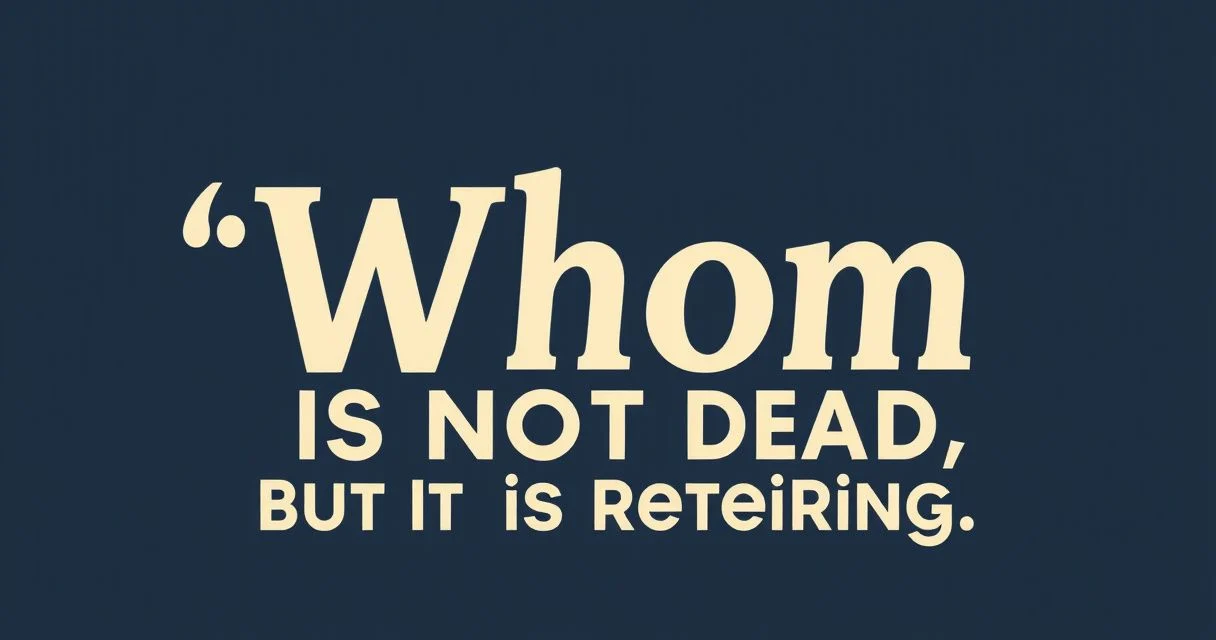
“Whom” Is Not Dead, But It Is Retiring
Whom is one of the last survivors of a case system English otherwise abandoned centuries ago. It is genuinely on the way out, and it is not gone yet, so it is worth knowing how it works and when to bother.
The rule
Who does things. Whom has things done to it.
Who is the subject, like he, she, they. Whom is the object, like him, her, them.
The he/him test
Answer the question with he or him. If him fits, use whom. The final m in both is the memory hook.
- Who/whom is calling? → He is calling. So: who.
- Who/whom did you invite? → I invited him. So: whom.
- To who/whom should I write? → Write to him. So: whom.
- Who/whom do you think will win? → He will win. So: who.
That last one catches people out constantly, because do you think sits between the pronoun and its verb. Cover the interruption and the answer is obvious.
The trap: after a preposition is not automatic
Many people learn whom follows a preposition, which is right often enough to be dangerous.
- To whom it may concern. Correct — whom is the object of to.
- Give it to whoever answers. Correct — whoever is the subject of answers. The whole clause is the object of to, not the pronoun.
Give it to whomever answers is a hypercorrection, the same species as between you and I. The pronoun takes its case from its own clause, not from the preposition sitting outside it.
Three times to skip it
In speech. Whom did you see? sounds studied in conversation. Who did you see? is standard spoken English and has been for generations.
When the sentence would end on it. Whom are you going with? is technically right and sounds strange. Either accept who, or rearrange to with whom are you going? — and then decide whether that suits your register.
When you are not sure. A wrong whom is more conspicuous than a wrong who, because it announces that an attempt was made. Readers forgive the plain version and notice the failed formal one.
Where it still holds
Whom is alive and expected in formal written English, legal drafting, and a handful of fixed phrases: to whom it may concern, for whom the bell tolls, whom shall I say is calling — that last being wrong, incidentally, and preserved anyway.
Merriam-Webster notes that whom has been declining for centuries and predicted to be dying since at least 1900. It is taking its time. Until it goes, the ten-second test costs nothing.
Checked against Merriam-Webster, the Chicago Manual of Style and the AP Stylebook. Spotted an error? Tell us — see our editorial policy.