Adjectives for Names: An A-Z List, Words to Describe a Name, and Adjectives From Names
“Adjectives for names” can mean three different things, and this page covers all three: adjectives that describe a name (unusual, old-fashioned, catchy, unisex), adjectives that go with a name in introduction games and acrostics (Amazing Amy, Brave Ben), and adjectives that are made from names (Victorian, Shakespearean, Italian).
If you are here for a name game, jump to the A-Z table. If you want to know whether a country name can be an adjective, or whether you can name a character with an adjective, those answers are under adjectives made from names and naming a character.
1. Adjectives that describe a name
Parents choosing a baby name, writers naming a character and anyone filling in a form all need words for the name itself.
| Adjective | What it says about the name | Example |
|---|---|---|
| common, popular | many people have it | Oliver has been a popular name for years. |
| unusual, uncommon, rare | few people have it | Her unusual name meant she was never confused with anyone else. |
| unique | the only one of its kind (often used loosely for “very unusual”) | They wanted a unique name and invented one. |
| classic, traditional, timeless | used for generations and never out of fashion | Elizabeth is a classic name with a dozen short forms. |
| old-fashioned, vintage | popular long ago; vintage is the kinder word | Vintage names such as Mabel and Arthur have come back. |
| modern, trendy, fashionable | recently popular; trendy hints that it may date | He thought the name too trendy to last. |
| catchy, memorable | easy to remember | A band needs a short, catchy name. |
| distinctive, striking | stands out | With a distinctive name like that, she is easy to find online. |
| unisex, gender-neutral | given to both boys and girls | Robin, Alex and Charlie are unisex names. |
| biblical | from the Bible | Biblical names such as Noah and Hannah remain in wide use. |
| royal, regal | borne by kings and queens, or sounding grand | They chose the regal name Victoria. |
| tongue-twisting, hard-to-pronounce | difficult to say | He shortened his tongue-twisting surname for the stage. |
| hyphenated, double-barrelled | two names joined (double-barrelled is British, for surnames) | She kept her double-barrelled surname, Lloyd-Evans. |
| fitting, apt | suits the person or thing | Storm was an apt name for a dog that hated baths. |
English also has fixed labels for kinds of name. In these, the first word works like an adjective: first name, given name, middle name, last name, family name, full name, maiden name, married name, pen name, stage name, pet name, brand name, household name. “She writes under a pen name” and “the company became a household name” are everyday examples.
One caution: calling someone’s name exotic, strange or weird can offend, because a name that is rare where you live may be ordinary where it comes from. Unusual and distinctive are safer.
Recommended resources for this topic
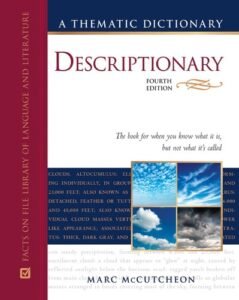
The Descriptionary
by Marc McCutcheon
A thematic dictionary that gives the exact word for things you can only describe.
Roget's Thesaurus of English Words and Phrases
by Peter Mark Roget
The classic thesaurus, arranged by idea, for finding a better word.
Merriam-Webster's Vocabulary Builder
by Mary Wood Cornog
Builds vocabulary through word roots, with quizzes along the way.
As an Amazon Associate we earn from qualifying purchases. Disclosure
2. A-Z adjectives to go with a name
In the classroom name game, each person introduces themselves with a positive adjective that starts with the same sound as their name: “I’m Cheerful Charlie.” It works because alliteration – repeating the opening sound – makes a name stick. The table gives three adjectives for every letter, with two names to show the pattern.
| Letter | Positive adjectives | Examples |
|---|---|---|
| A | amazing, adventurous, artistic | Amazing Amy, Adventurous Adam |
| B | brave, bright, bubbly | Brave Ben, Bubbly Bella |
| C | clever, caring, cheerful | Clever Carlos, Cheerful Charlie |
| D | daring, dependable, dazzling | Daring Dan, Dependable Daisy |
| E | energetic, eager, easy-going | Energetic Emma, Easy-going Ethan |
| F | friendly, funny, fearless | Friendly Fiona, Fearless Finn |
| G | generous, gentle, gifted | Gifted Gary, Gentle George |
| H | happy, helpful, honest | Helpful Hannah, Honest Harry |
| I | imaginative, inventive, independent | Imaginative Isla, Inventive Ivan |
| J | jolly, joyful, jazzy | Jolly Jack, Joyful Jasmine |
| K | kind, keen, kind-hearted | Kind Kate, Keen Kofi |
| L | lively, loyal, lucky | Loyal Leo, Lively Lucy |
| M | merry, musical, marvellous | Musical Maya, Marvellous Max |
| N | nice, neat, nimble | Nimble Noah, Neat Nina |
| O | optimistic, outgoing, original | Optimistic Oliver, Outgoing Olivia |
| P | patient, playful, polite | Patient Priya, Playful Paul |
| Q | quick, quiet, quirky | Quick Quinn, Quirky Queenie |
| R | reliable, radiant, resourceful | Radiant Rosa, Reliable Ryan |
| S | smart, sunny, sporty | Sporty Sam, Sunny Sofia |
| T | thoughtful, talented, trustworthy | Talented Tara, Thoughtful Tom |
| U | upbeat, understanding, unstoppable | Upbeat Uma, Unstoppable Uri |
| V | vibrant, valiant, versatile | Valiant Victor, Vibrant Violet |
| W | witty, warm, wise | Witty Will, Warm Wendy |
| X | (use the sound: excellent, exciting, zany) | Excellent Xavier, Zany Xander |
| Y | youthful, young-at-heart (positive Y words are scarce) | Youthful Yara, Young-at-heart Yusuf |
| Z | zany, zesty, zippy | Zesty Zoe, Zippy Zack |
Match the sound, not the spelling
Alliteration is about what you hear. A few names need an adjective from a different row:
- Chris, Chloe begin with a K sound: Kind Chris, Clever Chloe.
- Cindy, Celia begin with an S sound: Sincere Cindy, Sunny Celia.
- George, Gina begin with a J sound: Gentle George, Generous Gina, Joyful George. Gary has a hard G: Gifted Gary.
- Phil, Phoebe begin with an F sound: Funny Phil, Friendly Phoebe.
- Xander, Xena begin with a Z sound: Zany Xander.
- A silent letter does not count: knowledgeable goes with Nora, not with Kate.
An introduction for your name using adjectives
For a spoken introduction, give the adjective and one reason. The reason is what people remember.
- “Hi, I’m Musical Maya. I play the violin, badly, every evening.”
- “I’m Daring Dan, because I once ate a whole chilli for a bet.”
- “My name is Priya, and my adjective is patient – I have three little brothers.”
For a written acrostic, put the name down the page and choose an adjective for each letter. Check that every word is true of the person and that you have not used the same idea twice.
| Letter | Adjective | Why |
|---|---|---|
| S | Sporty | plays football every Saturday |
| O | Optimistic | always expects to win |
| F | Funny | does voices at the dinner table |
| I | Imaginative | invents her own board games |
| A | Affectionate | hugs the dog before school |
If you need more choice for one letter, there are full letter lists on this site, starting with adjectives that start with A and adjectives that start with G. For words about character in general, see adjectives for people.
3. Adjectives made from names
An adjective formed from a proper noun – the name of a person, place, people or religion – is called a proper adjective, and in English it keeps its capital letter. There is a full treatment in proper adjectives; the tables here show the main patterns.
From people
| Adjective | From | Meaning | Example |
|---|---|---|---|
| Victorian | Queen Victoria | of her reign (1837-1901); also strict or prudish | a row of Victorian terraced houses |
| Elizabethan | Elizabeth I | of her reign | Elizabethan theatre |
| Shakespearean | William Shakespeare | by or like Shakespeare | a Shakespearean tragedy |
| Dickensian | Charles Dickens | like his novels, especially grim poverty | Dickensian working conditions |
| Kafkaesque | Franz Kafka | nightmarishly bureaucratic and illogical | a Kafkaesque visa process |
| Orwellian | George Orwell | like the controlling state in Nineteen Eighty-Four | Orwellian surveillance |
| Machiavellian | Niccolò Machiavelli | cunning and unscrupulous in seeking power | a Machiavellian plot |
| Freudian | Sigmund Freud | relating to his ideas about the unconscious | a Freudian slip |
| Darwinian | Charles Darwin | relating to evolution by natural selection | Darwinian theory |
| Napoleonic | Napoleon Bonaparte | of Napoleon or his era | the Napoleonic Wars |
The usual endings are -an / -ian (Victorian, Freudian), -esque (Kafkaesque, Pythonesque), -ic (Napoleonic, Homeric) and -ean (Shakespearean, Herculean). You can coin one from almost any well-known name, and journalists do, but a new coinage only works if readers know the person.
From places: can a country name be an adjective?
Most countries have a separate adjective, and that is the form to use before a noun: French wine, not “France wine”.
| Place | Adjective | Example |
|---|---|---|
| Italy | Italian | Italian opera |
| France | French | a French film |
| Spain | Spanish | Spanish guitar |
| Peru | Peruvian | Peruvian textiles |
| Thailand | Thai | Thai cooking |
| the Netherlands | Dutch | Dutch painters |
| Switzerland | Swiss | a Swiss watch |
| Kenya | Kenyan | Kenyan athletes |
| Paris, Venice, Glasgow | Parisian, Venetian, Glaswegian | a Parisian cafe |
The country name itself can stand before a noun in a few cases. Some countries have no everyday adjective, so the name does the job: New Zealand lamb, a United States senator, UK law, US policy. Sports writing uses the name for a national side: “the France team”, “the England captain”. And some fixed names keep the noun: a Canada goose, a Panama hat. In all of these the name is a noun acting as a modifier; it is not a true adjective, which is why you cannot say “the lamb is very New Zealand” in careful writing.
Capital letters
- Keep the capital on a proper adjective: Victorian, Italian, Buddhist, Shakespearean. English also capitalises nationalities and languages every time, unlike French, Spanish or Italian.
- A prefix stays in lower case, with a hyphen: pre-Victorian, post-Soviet, anti-European, un-American.
- The capital is dropped when a word has drifted away from the name: quixotic (Don Quixote), draconian (Draco, the Athenian lawgiver), platonic for a friendship (Plato), mesmerising (Franz Mesmer), titanic (the Titans), jovial (Jove), mercurial (Mercury).
- Some are in between. Dictionaries and style guides differ on herculean or Herculean, french fries or French fries, venetian blinds or Venetian blinds. Pick one guide and follow it.
Names that are adjectives, and names from virtues
Some given names and nicknames are ordinary adjectives: Sunny, Happy, Lucky, Merry, Golden, Sterling, Royal, Noble, True, Rusty, Sandy, Stormy, Misty, Red. Others match an adjective by sound or by history: Frank (frank means honest and direct), Ernest (earnest means serious and sincere – the joke at the centre of Oscar Wilde’s The Importance of Being Earnest), Blythe (blithe means carefree), Bonnie (Scots bonny, pretty), Clement (mild, merciful) and Constant. A few come from Latin adjectives: Felix (happy, lucky), Clara (bright, clear) and Hilary (cheerful).
Virtue names are a slightly different case. Grace, Faith, Hope, Joy, Patience, Prudence, Charity, Felicity, Verity and Constance are nouns, not adjectives; the matching adjectives are graceful, faithful, hopeful, joyful, patient and prudent. Such names were especially popular with English Puritans in the sixteenth and seventeenth centuries, and several have never gone out of use.
Can I name a character with an adjective?
Yes, and writers have done it for centuries. An adjective name tells the reader at once what to expect, so it suits comedy, allegory and children’s stories best.
- John Bunyan’s The Pilgrim’s Progress (1678) has characters called Faithful and Hopeful.
- In Sheridan’s comedy The Rivals (1775), Lydia Languish and Sir Anthony Absolute behave just as their surnames promise.
- Disney’s Snow White and the Seven Dwarfs (1937) named six of its seven dwarfs with adjectives: Grumpy, Happy, Sleepy, Bashful, Sneezy and Dopey. Only Doc is the exception.
- Roger Hargreaves’s Mr. Men and Little Miss books are built on the idea: Mr. Happy, Mr. Grumpy, Little Miss Naughty.
In realistic fiction a bare adjective name can feel heavy-handed. Three quieter options: use a real name that happens to be an adjective (Frank, Sunny, Ernest); use the adjective as a nickname the other characters gave (“everyone called him Lucky, and nobody could remember why”); or play against it, with a timid man called Victor or a gloomy girl called Joy.
Putting an ordinary adjective in front of a name
English is fussy here. You cannot freely write “Tall Maria plays basketball” or “Clever John solved the puzzle”; outside games and nicknames, that sounds like a children’s book. What the language does allow:
| Pattern | Examples | Note |
|---|---|---|
| feeling words, no article | poor Tom, dear Anna, lucky Sam, good old Fred, little Mia, young Mr Lee | They show the speaker’s attitude, not a fact about the person. |
| the + adjective + name | the late Mr Smith, the famous Dr Livingstone, the young Mozart | Identifies which person, or which stage of a life. |
| a / an + adjective + name | A furious Maria slammed the door. | A journalist’s device for a temporary state. |
| name + the + adjective | Alexander the Great, Ivan the Terrible, Pliny the Elder, Charles the Bald | A historical epithet; the adjective takes a capital. |
| adjective nickname | Honest Abe, Little John, Good Queen Bess | The adjective has become part of the name, so it is capitalised. |
Everywhere else, describe the person in the normal way: “Maria, who is tall, plays basketball” or “Maria is tall and plays basketball”. And a bare name takes no article: “John is my friend”, never “The John is my friend”.
Practice
- Which adjective alliterates with Chris: cheerful, kind or sincere?
- Correct the capital letters: “We studied victorian novels and italian art in the Pre-Raphaelite room.”
- Choose: She ordered a (France / French) wine.
- Which of these names are nouns, not adjectives: Sunny, Faith, Lucky, Patience?
- What does Kafkaesque describe: a happy ending, a frightening and senseless official process, or a long novel?
- Fix the sentence: “The John is my best friend.”
- Give a kinder word than old-fashioned for a name like Mabel.
- Write the epithet correctly: alexander the great.
Answers: 1 kind (Chris starts with a K sound). 2 Victorian, Italian; Pre-Raphaelite is already right. 3 French. 4 Faith and Patience. 5 A frightening and senseless official process. 6 “John is my best friend.” 7 Vintage, classic or traditional. 8 Alexander the Great.
Quick answers
What is a good adjective for my name?
Take the first sound of your name, find that row in the A-Z table, and choose the word that is most true of you. A true adjective with a one-line reason beats an impressive one.
Can a country name be an adjective?
Usually the country has its own adjective (Spain, Spanish). The bare name is used before a noun only where no handy adjective exists (New Zealand lamb, US policy), in sports writing (the France team) and in some fixed names (Canada goose).
Can I name my character an adjective?
Yes. Happy, Grumpy, Faithful and Mr. Happy are all established examples. It suits comic and allegorical stories; in realistic fiction, make it a nickname or choose a real name that is also an adjective, such as Frank or Sunny.
Is a name a noun or an adjective?
A name is a proper noun. It can act like an adjective before another noun (a Shakespeare play), and it can be turned into a proper adjective (a Shakespearean play).
Do adjectives made from names need a capital letter?
Yes, as long as the link to the name is still felt: Victorian, Italian, Freudian. Words that have drifted free, such as quixotic and draconian, are written in lower case.
For the basics of the word class, see what is an adjective.
Checked against Merriam-Webster, the Chicago Manual of Style and the AP Stylebook. Spotted an error? Tell us — see our editorial policy.