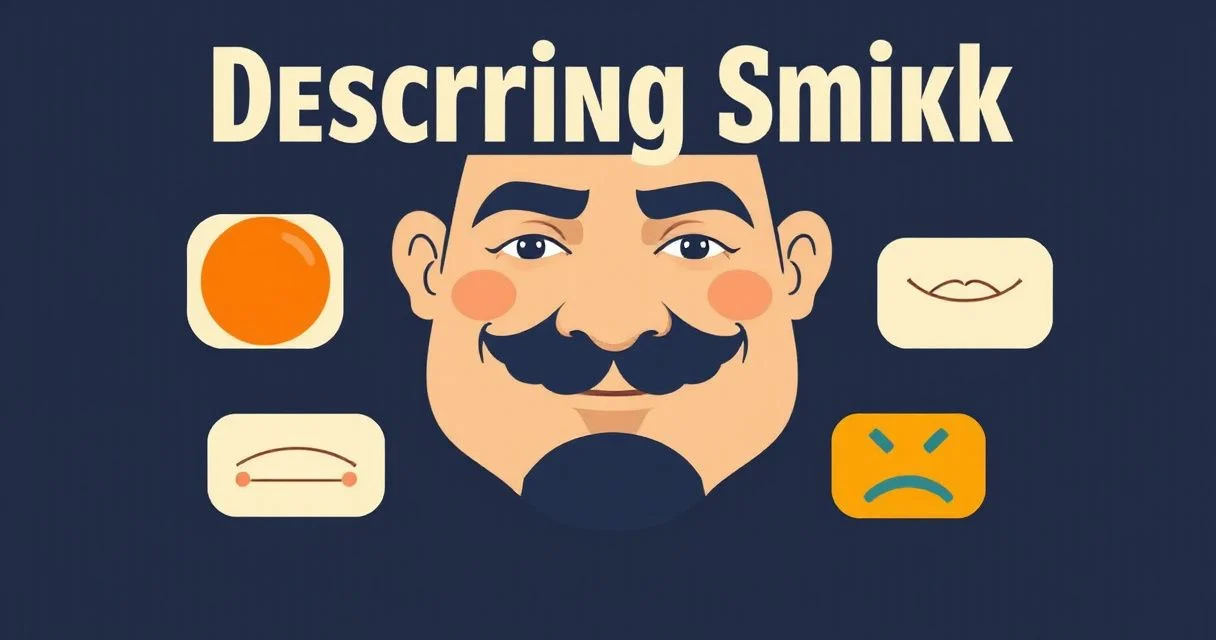
Describing a Smirk: A Guide to Adjectives for Smirks
The most useful adjectives for a smirk are smug, knowing, sly, self-satisfied, mocking, confident, cocky, wry, faint, lopsided and triumphant. A smirk is a small, often one-sided smile that suggests the person feels pleased with themselves, knows something others don’t, or is quietly mocking someone, so the adjective you choose tells the reader which of those it is. Below are smirk adjectives grouped by meaning, with example sentences, words for how a smirk looks on the face, the difference between a smirk, a grin and a sneer, and a short practice.
Quick picker
| What the smirk shows | Adjectives |
|---|---|
| pleased with themselves | smug, self-satisfied, complacent, superior |
| confidence | confident, cocky, self-assured, arrogant |
| a secret or private joke | knowing, sly, secretive, conspiratorial, mischievous |
| mockery | mocking, scornful, contemptuous, derisive, sardonic |
| dry humour | wry, amused, ironic, dry, sardonic |
| winning | triumphant, victorious, gloating |
| flirting or teasing | flirtatious, teasing, playful, impish, roguish |
| appearance | faint, slight, lopsided, crooked, half, tight-lipped, barely there |
Recommended resources for this topic
The Descriptionary
by Marc McCutcheon
A thematic dictionary that gives the exact word for things you can only describe.
Roget's Thesaurus of English Words and Phrases
by Peter Mark Roget
The classic thesaurus, arranged by idea, for finding a better word.
Merriam-Webster's Vocabulary Builder
by Mary Wood Cornog
Builds vocabulary through word roots, with quizzes along the way.
As an Amazon Associate we earn from qualifying purchases. Disclosure
Smug and self-satisfied smirks
This is the most common meaning. Dictionaries define a smirk as a smile that is unpleasant or silly because the person is pleased with themselves, so these adjectives fit naturally.
- smug – too pleased with yourself. He gave a smug smirk when the teacher praised his essay in front of everyone.
- self-satisfied – pleased with your own achievement, in an irritating way. “Told you so,” she said, with a self-satisfied smirk.
- complacent – too satisfied to notice danger. His complacent smirk faded when the results came in.
- superior – suggests you think you are better than others. She looked down at the map with a superior smirk.
- condescending / patronising – treating someone as less clever. “Do you need me to explain it again?” he asked, with a condescending smirk.
Confident and cocky smirks
If you want to describe a confident smirk, decide whether the confidence is attractive or irritating.
- confident – sure of yourself; neutral to positive. The champion stepped into the ring with a confident smirk.
- self-assured – calm confidence. a self-assured smirk that said she had already won the argument
- cocky – too confident, often young and showy; informal. The cocky rookie flashed a smirk at the cameras.
- arrogant – confidence that looks down on others. His arrogant smirk made the other players want to beat him even more.
- cool / unbothered – calm, untouched by pressure. She answered the hostile question with a cool little smirk.
To show confidence without saying “confident”, describe the body: He leaned back, crossed his arms and let one corner of his mouth lift.
Knowing, sly and secret smirks
- knowing – shows they understand something others don’t, or share a secret. When the boss mentioned “a surprise”, Maya gave me a knowing smirk.
- sly – clever and a little sneaky. The fox in the story wears a sly smirk.
- secretive – hiding something. a secretive smirk over the top of her newspaper
- conspiratorial – shared by people “in on” something. The twins exchanged a conspiratorial smirk.
- mischievous / impish – planning harmless trouble. The child’s mischievous smirk told me the cake was in danger.
- enigmatic / inscrutable – hard to read. He met every question with the same enigmatic smirk.
Mocking and scornful smirks
- mocking – makes fun of someone. The bully’s mocking smirk followed him down the corridor.
- scornful / contemptuous – shows someone is not worth respect. She looked at the cheap gift with a contemptuous smirk.
- derisive – openly ridiculing. a derisive smirk at the very idea
- sardonic – grimly mocking, often about a bad situation. “Lovely weather for a picnic,” he said with a sardonic smirk as the rain came down.
- sneering – a smirk turning into a sneer. See the comparison below.
Wry and amused smirks
Not every smirk is unkind. These suggest dry humour, often about yourself or an awkward situation.
- wry – dry, slightly ironic amusement. She gave a wry smirk when her own advice was quoted back to her.
- amused – finds something funny but doesn’t laugh. The judge listened with an amused smirk.
- ironic – recognises that the situation is the opposite of what was expected.
- dry – humour without obvious emotion. a dry little smirk
- rueful – amused but a little sorry or regretful. He held up the burnt toast with a rueful smirk. (Rueful smile is more common, but rueful smirk is used.)
Triumphant and gloating smirks
- triumphant – after winning. She laid down the winning card with a triumphant smirk.
- victorious – similar, slightly more formal.
- gloating – enjoying someone else’s loss. His gloating smirk when I missed the penalty was hard to forgive.
- vindicated – proved right after doubt. a vindicated smirk (more often: she looked vindicated).
Flirtatious and teasing smirks
- flirtatious – shows romantic interest playfully. He caught her eye across the room with a flirtatious smirk.
- teasing – playfully provoking. “Lost again?” she asked, with a teasing smirk.
- playful – light, fun. a playful smirk
- roguish – charmingly naughty, often for a likeable rule-breaker. the pirate’s roguish smirk
- suggestive – hints at something, often romantic or rude.
Nervous and awkward smirks
Sometimes a smirk is not about confidence at all. People smirk when they are embarrassed, when they are trying not to laugh at a bad moment, or when they don’t know how to react.
- nervous – He gave a nervous smirk when the teacher asked who had broken the window.
- awkward / embarrassed – an awkward smirk after the joke fell flat
- guilty / sheepish – caught doing something. The dog wasn’t the only one with a guilty look; my brother wore a sheepish smirk and crumbs on his shirt.
- uncontrollable / irrepressible – can’t be hidden. She tried to look serious, but an irrepressible smirk kept breaking through.
Smirks for different characters
In stories, the same smirk can mean different things depending on who wears it.
- A villain: cold, cruel, menacing, gloating, superior. The villain’s cold smirk told her he had planned for this.
- A likeable rogue or hero: roguish, cocky, lopsided, boyish, devil-may-care. He tipped his hat with a roguish smirk and vanished into the crowd.
- A detective or clever character: knowing, satisfied, wry, quiet. The inspector allowed himself a small, satisfied smirk.
- A teenager: insolent, sulky, cheeky, defiant. an insolent smirk at the back of the class
- A rival: taunting, provoking, challenging. a taunting smirk across the court
How a smirk looks
These adjectives describe the shape rather than the meaning. They are useful in fiction when you want the reader to see it.
- faint / slight / barely there – small and subtle. A faint smirk crossed his face and was gone.
- lopsided / crooked / one-sided – higher on one side, the classic smirk shape. a lopsided smirk
- half – a half-smirk, only partly formed.
- tight-lipped – lips pressed together, holding back a laugh.
- broad / wide – a big smirk, becoming a grin. a broad smirk of satisfaction
- lingering – stays on the face. a lingering smirk
- fleeting – over in a moment.
- suppressed / poorly hidden – trying not to show it. a poorly hidden smirk
Add a body detail: the corner of her mouth twitched, one eyebrow rose, his lip curled, she looked away, smirking. For other expressions, see adjectives for face.
Smirk, smile, grin, sneer: what is the difference?
| Word | What it shows | Example |
|---|---|---|
| smile | general pleasure or friendliness | She smiled warmly at the new student. |
| grin | a wide, open smile, often showing teeth; usually happy | He grinned from ear to ear. |
| smirk | a small, often one-sided smile of self-satisfaction, a secret or mockery | He smirked as his rival tripped. |
| sneer | an expression of open contempt, upper lip raised; nastier than a smirk | “You? A singer?” she sneered. |
| simper | a silly, false, over-sweet smile | She simpered at the director. |
So a “kind smirk” or “warm smirk” sounds odd; for kindness choose smile. Our page of adjectives for smile covers the friendly side.
How to describe a smirk in writing
People who search “how to describe a smirk” usually want it to show character. A few practical tips:
- Use one adjective, not three. A knowing smirk is stronger than a sly, knowing, secretive smirk.
- Show the cause. The reader should understand why the character smirks. When the head teacher announced that the trip was cancelled, Leo, who hated coaches, smirked.
- Show the reaction. A smirk usually affects someone else. Ella saw the smirk and felt her face burn.
- Don’t overuse it. If a character smirks on every page, it becomes a tic. Mix in other actions: a raised eyebrow, a shrug, a silence.
Example paragraph:
Marcus read the email twice, then leaned back in his chair. The faint, lopsided smirk that crept across his face told me everything: the client had chosen us, and he’d known they would since Tuesday.
Grammar notes
- Smirk is both a noun and a verb. Noun: a smug smirk. Verb: He smirked. The verb takes at: She smirked at me.
- Adjective forms: smirking (a smirking face) and the informal smirky (a smirky look).
- Common collocations: give a smirk, wear a smirk, wipe the smirk off someone’s face, suppress a smirk, with a smirk.
- Wipe that smirk off your face! is a fixed phrase meaning “stop looking so pleased with yourself”.
Words that are easy to misuse
- Smirk vs smile. Don’t use smirk when the person is simply happy. The bride smirked as she walked down the aisle makes her sound smug.
- Sardonic vs sarcastic. Sarcastic describes words; sardonic describes a manner or expression. A sardonic smirk sounds more natural than a sarcastic smirk, though both are used.
- Wry is not the same as mocking; it is gentle and often self-aware.
- Smug and smirk overlap so much that a smug smirk is close to repetition. It is common in speech, but in careful writing pick another adjective or none.
Common mistakes
| Incorrect | Correct |
|---|---|
| She smirked to me. | She smirked at me. |
| He gave a warm, friendly smirk to the nervous child. | He gave a warm, friendly smile to the nervous child. |
| Her face was very smirk. | Her face wore a smirk. / She was smirking. |
| He smirked a wide toothy grin. | He grinned widely. / He smirked. |
| Wipe the smirk from off your face. | Wipe that smirk off your face. |
Practice
Choose the best adjective.
- After winning the bet, he gave a (triumphant / rueful) smirk.
- She knew about the surprise party and gave me a (knowing / contemptuous) smirk.
- The bully’s (mocking / flirtatious) smirk made the new boy look away.
- He laughed at his own mistake with a (wry / gloating) smirk.
- Only the corner of her mouth moved: a (faint / broad) smirk.
- The new player was far too sure of himself, with a (cocky / rueful) smirk for the cameras.
Answers: 1 triumphant, 2 knowing, 3 mocking, 4 wry, 5 faint, 6 cocky.
FAQ
Is a smirk always negative?
Not always, but usually it carries a hint of self-satisfaction or teasing. Wry, playful and flirtatious smirks can be likeable; smug and mocking ones are not.
What is a good word for a confident smirk?
Self-assured if the confidence is attractive, cocky or arrogant if it is irritating.
How do you describe a smirk without using the word?
Describe the movement: one corner of his mouth lifted, her lips twitched, he tried not to look pleased and failed.
Where does the word smirk come from?
It comes from Old English smercian, which simply meant “to smile”. The unpleasant, self-satisfied sense developed later, which is why a smirk still sits so close to a smile.
Can a smirk be attractive?
In romance writing it often is: a lopsided, roguish or teasing smirk suggests confidence and playfulness. Context and the other character’s reaction decide whether it charms or annoys.
What is the opposite of a smirk?
There is no exact opposite, but a frown, a scowl or an open, genuine smile each contrast with it in different ways.
For more on facial expressions linked to happiness, see adjectives for happy.
Checked against Merriam-Webster, the Chicago Manual of Style and the AP Stylebook. Spotted an error? Tell us — see our editorial policy.